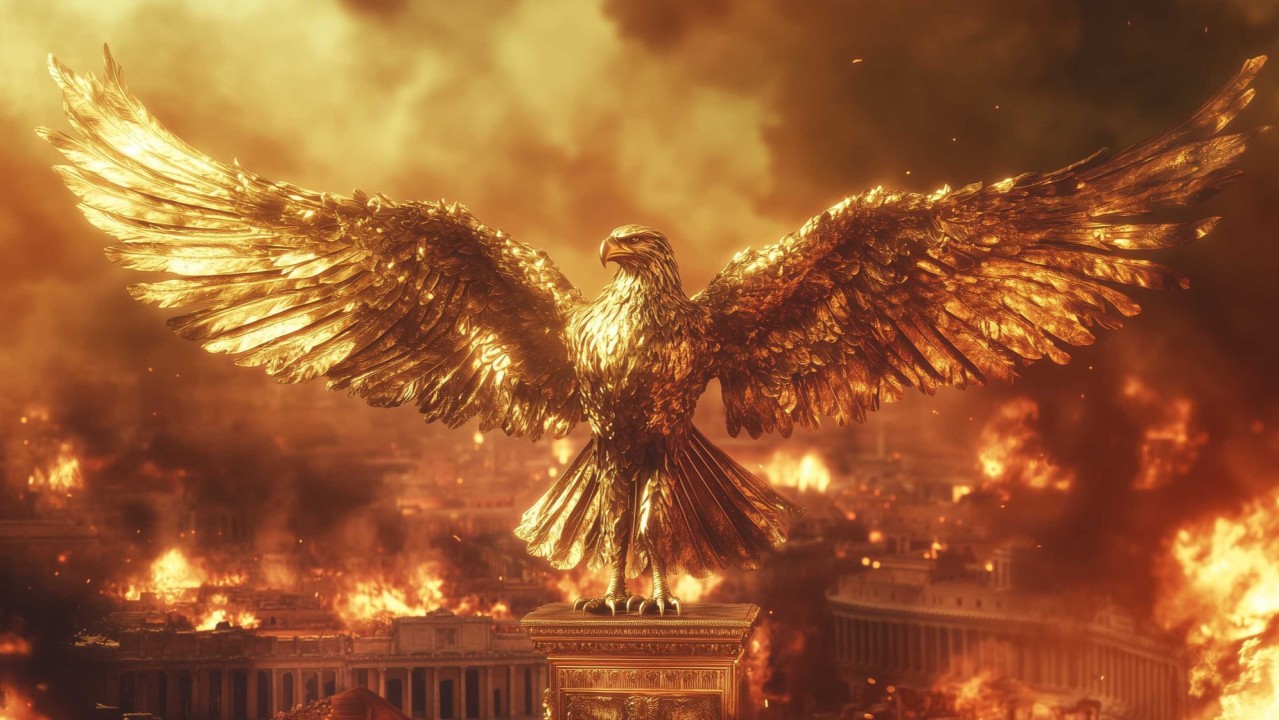
What happens when power outgrows wisdom? When a president plays emperor and the centre of a republic tilts toward collapse? From Caesar to Churchill to Trump, leadership has shaped the fate of empires more than laws or ideologies ever could.
Three men, men separated by centuries, bound by consequence—show how nations fray from the top.
The Empire Mirror: A Quick Comparison
Mental Stability:
Trump: Volatile, reactive
Commodus: Delusional, self-absorbed
Churchill: Stubborn, depressive, but focused
Vision:
Trump: Nostalgic nationalism
Commodus: Personal cult
Churchill: Global democratic resilience
Right to Rule:
Trump: Democratic, norm-eroding
Commodus: Inherited, increasingly illegitimate
Churchill: Democratic, bolstered by crisis
Cohort Strength:
Trump: Loyalty > competence
Commodus: Cronies, conspirators
Churchill: Experts, generals, MPs
Economic Impact:
Trump: Tax cuts for wealthy, trade war damage
Commodus: Depleted treasury
Churchill: Austerity, postwar recovery planning
Compassion:
Trump: Selective, symbolic (i.e., actions meant to look empathetic without real empathy)
Commodus: Indifferent
Churchill: Deep rhetorical empathy
Big Mistakes:
Trump: Jan. 6, COVID, abandonment of alliances
Commodus: Military weakening, internal decay
Churchill: Colonial overreach, Suez blindness
I. Trump: Performance over Governance
Mental Stability Trump led with instinct, ego, and impulse. Social media wasn’t a sideshow—it was the show. Diplomats, investors, and allies all tuned in nervously.
Anecdote: In 2017, Trump turned to military brass in the White House and declared, “This is the calm before the storm.” No one—not even his generals—knew what storm he meant.
The vision “Make America Great Again” was a slogan of grievance, not strategy. Empires need forward motion. Trump pointed backward.
Right to Rule He won fairly, then tried to rule unilaterally—attacking judges, discrediting elections, and stretching every norm of democracy.
Cohort Strength Competence was a threat; loyalty, the currency. The result? Policy drift, internal chaos, and strategic paralysis.
Economic Policy Trump’s tax cuts ballooned the deficit and enriched the wealthy. Trade wars backfired. The populist wrapping hid a plutocratic core.
Moral Leadership Family separations. COVID minimization. Racial division. Trump governed with an eye on ratings, not empathy.
Truth and Propaganda Fact-checkers logged over 30,000 false claims. He didn’t try to persuade. He flooded the zone with noise.
Big Mistakes
Mishandling COVID
Undermining elections
Inciting January 6
Abandoning global alliances
II. Rome and Britain: Echoes from the Archive
Abandoning Alliances Trump actively distanced the United States from traditional allies and multilateral organizations: NATO, the World Health Organization, the Paris Climate Accord, and various trade agreements. He saw alliances as burdens, not as the scaffolding of American influence. The result was a fraying of the postwar order America helped build.
Commodus, too, weakened Rome's military cohesion. He neglected border provinces, cut funding to legions, and leaned on personal bodyguards instead of unified command. Rome’s influence decayed at the edges.
In contrast, Churchill doubled down on alliances. Despite Britain’s waning empire, he strengthened ties with the U.S. and rallied the Commonwealth in WWII. His genius wasn’t just strategy. It was a coalition.
Commodus: The Empire as Stage He dressed as Hercules, fought in the Colosseum, and renamed Rome after himself. Underneath the theatrics: economic decay and creeping chaos.
Anecdote: Commodus declared all months to be named after his titles. He was emperor, demigod, and calendar.
Churchill: The Empire in Crisis He rallied Britain during its darkest hours with words and presence. Even he could not stop the sun from setting on the empire.
Anecdote: During air raids, Churchill walked London’s rubble-strewn streets. Not for show—for solidarity.
Institutional Cracks
Rome’s Senate faded to irrelevance.
Britain’s empire rotted from overreach.
America’s Congress? Gridlocked, performative, timid.
III. Resistance and Resilience
Empires rarely implode. They unravel. Slowly, until suddenly.
United States: Judges, journalists, career civil servants, and the Democratic Party slowed Trump’s slide toward autocracy.
United Kingdom: Parliament and the Labour Party provided course correction in post-imperial drift.
The Crown: Queen Elizabeth II (and now King Charles) offered continuity—symbolic, not legislative, but grounding nonetheless.
These weren’t revolutions. They were brakes. And brakes buy time.
IV. California: The Soft Secession
California isn’t seceding. But it’s not waiting.
It behaves like a sovereign actor inside a decaying structure:
5th largest economy on Earth
100+ lawsuits against the Trump administration
Independent climate treaties, immigration rules, and foreign partnerships
Like Gaul before Rome’s decline—or India before Britain’s withdrawal—California is writing its own terms.
V. Final Thought: What Comes Next
Trump hasn't ended America. He is testing it.
What follows depends not just on the next president but on whether Americans choose empire or repair the republic.
Watch California. Watch Congress. And above all, watch what truths Americans are willing to believe next.
Postscript: The View from the Future (Asimov Would Understand)
The decline of empires is not a failure of strength but of foresight. Trump is not the anomaly; he is the inevitability. A symptom of entropy expressed as personality.
Commodus, Trump, and every fading figurehead in history share one flaw: they inherit more power than understanding. They simulate power but cannot wield it.
In the world of Foundation, such men accelerate collapse. In our world, they do the same, but with real consequences. Unless Americans rediscover the long arc of planning, what follows will not be a Second Foundation. It will be fragmentation.