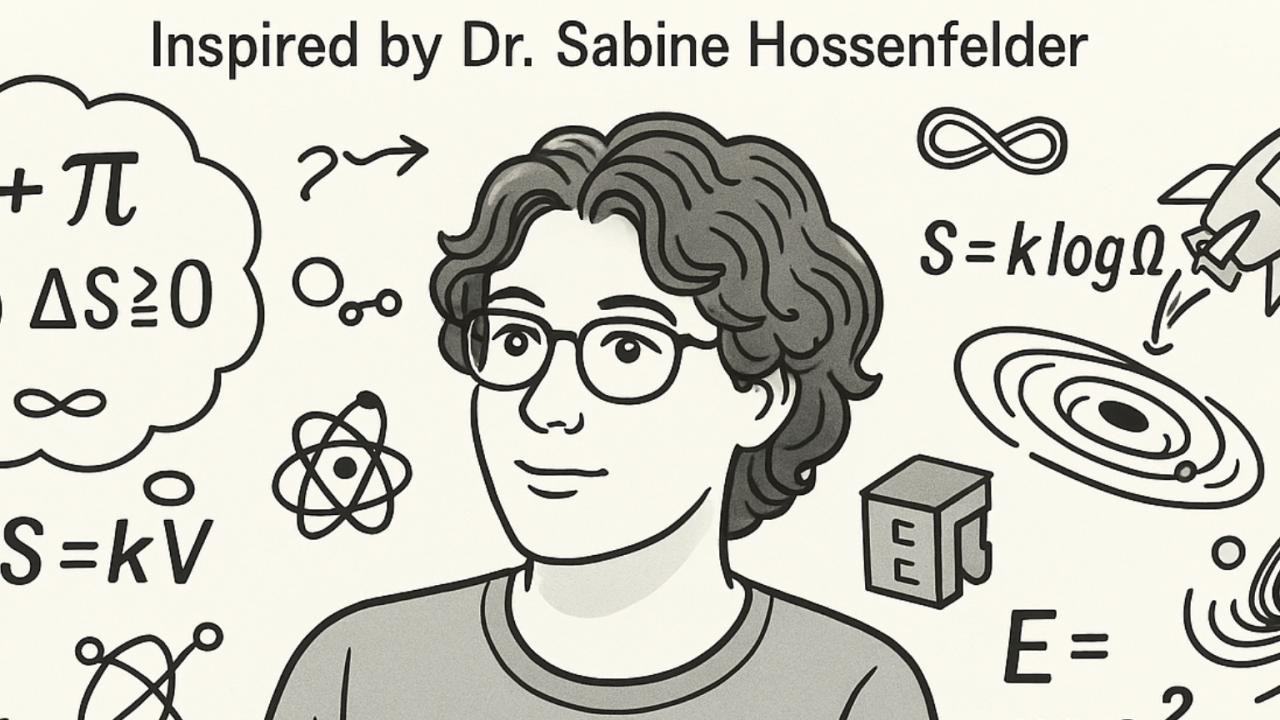
A personal reflection, inspired by the work of Dr. Sabine Hossenfelder
When I can’t sleep, I don’t count sheep. I think about paradoxes — the kind that remind you just how little we actually know.
Recently, I watched a video by Dr. Sabine Hossenfelder, a theoretical physicist I admire, who listed ten open problems in physics that have no clear answers. I thought about them for days. Some I’d heard before. Some I’ve puzzled over for years. All of them felt honest.
What follows isn’t an attempt to solve them — I’m not that delusional. But it is my attempt to walk around them, consider what they say about us, and maybe, just maybe, pull something useful from the not-knowing.
So: here are ten of the best questions we can ask. And a few thoughts about why the asking might matter more than the answer.
1. Boltzmann Brains
What if your brain is a cosmic accident?
In an eternal universe, particles can randomly organize into anything — including a fully formed brain that thinks it’s you. These “Boltzmann brains” should appear more often than evolved beings. That’s the paradox.
So what do we do with that? Maybe it's a clue that something’s off with our model of the universe. Or maybe probability doesn’t work the way we think it does in infinite systems. Or maybe — and this one’s a little spooky — we are hallucinations. But we’re good at it.
2. Why Real Numbers?
Quantum physics uses imaginary numbers. Why do we only see the real part?
All the elegant machinery of quantum theory runs on complex numbers. But when we measure anything — position, spin, energy — we always get a real number. Why does the imaginary part never show up?
Could be:
We’re only seeing the outputs that our instruments are built to detect.
Or maybe the imaginary part is like scaffolding: vital for the construction, but invisible in the final structure.
Or maybe there’s a deeper, real-only theory hiding under it all.
3. The Black Hole Information Paradox
Do black holes destroy information?
Quantum mechanics says information can’t be destroyed. But black holes — at least as Hawking described them — seem to do exactly that. Nothing comes out but random radiation.
Possible resolutions:
The information is encoded in the Hawking radiation, just too scrambled for us to decode.
It’s stored on the event horizon in a kind of cosmic ledger (the holographic principle).
Or the theory’s incomplete, and quantum gravity will give us new rules.
4. Quantum Gravity
Can gravity be in two places at once?
Quantum particles can exist in a superposition — multiple locations at once. But gravity, in Einstein’s view, is smooth and classical. So what happens to a particle’s gravitational field when it’s in two places?
This is the heart of the search for a quantum theory of gravity.
Maybe gravity is quantized, and we just haven’t figured out how.
Maybe gravity is emergent — not fundamental at all.
Or maybe our assumptions are wrong on both sides.
5. The Fermi Paradox
If the galaxy is full of planets, where are the aliens?
We’ve found thousands of planets. Life’s chemistry seems easy. So why is the sky so quiet?
Here’s the version I lean toward: Civilizations probably do arise. But like fireworks, they don’t last long. Most may burn out before they get very far. And the galaxy is so big and so old that the odds of two intelligent species popping up near each other — at the same time — are basically nil.
This isn’t the “Great Filter” (which says civilizations usually die off early). This is simpler: they might not die early, they just don’t sync up. They’re gone before we arrive. We’ll be gone before the next ones wake up.
In short: It's not that nobody's out there. It's just that nobody's home — right now.
6. Complexity and Emergence
Why does the universe get more interesting over time?
The early universe was boring — just hydrogen and some heat. Now we have nebulae, consciousness, and jokes about Schrödinger’s cat. Why?
We don’t have a strong theory of why complexity emerges, or even a solid definition of it. Maybe it’s driven by entropy. Maybe it’s just what atoms do when left unsupervised. Either way, the trend is clear: things start simple, and they don’t stay that way.
7. The Grandfather Paradox
Can time travel coexist with causality?
If time travel is possible, what’s to stop you from going back and preventing your own existence?
There are a few ways out:
Maybe paradoxes are impossible — time loops always self-correct (Novikov’s principle).
Maybe every change spawns a new timeline (many-worlds).
Or maybe time travel isn’t physically possible and we’re saved by bad engineering.
8. The Arrow of Time
Why does time go forward?
The laws of physics don’t care about direction. But we do. We remember the past, not the future. Why?
The usual answer is entropy — things tend toward disorder. But entropy isn’t a fundamental quantity; it depends on how we define "order." Maybe it’s about initial conditions. Maybe it’s about the nature of observation. Or maybe time is just what consciousness feels like when matter moves.
9. Schrödinger’s Cat
Why don’t we see things in quantum superposition at human scale?
At the particle level, objects exist in multiple states until observed. But we never see cats that are both alive and dead.
So what breaks the illusion?
Maybe it’s decoherence — quantum states collapse when they interact with their environment.
Maybe there’s a physical limit — mass, size, or time — beyond which superpositions can't survive.
Maybe the act of observation really does collapse the wavefunction.
Or maybe all outcomes happen — we just live in one branch of the tree.
10. The Transporter Paradox
If you’re disassembled and rebuilt elsewhere — are you still you?
Star Trek’s transporter scans you, destroys the original, and builds a copy. Is that still “you”? Or did you die, and a new “you” was born, thinking nothing happened?
It depends what you think a person is:
A pattern? Then yes — you persist.
A continuous experience? Then maybe not.
Something more? Then we may never know.
And one small credit where it’s long overdue: Thank you to Desilu Studios — and writer John D. F. Black, who penned “The Enemy Within” (1966), the first Star Trek episode to seriously wrestle with this question. They dropped a transporter paradox into the world’s hive mind — and we’ve all been chewing on it ever since.
(And if Star Trek gave us the machine, Douglas Adams gave us the warning: never ask a machine to solve the deepest questions of existence. You might get an answer like “42” — and forget what the question was.)
Or as Descartes didn’t quite say: I transport, therefore I... huh.
Postscript: When the Questions Shape the Answers
There’s something strange about the deepest questions we ask.
Sometimes, like a quantum particle, the act of measuring changes the thing being measured. Maybe some truths are like that. The closer we get, the more they collapse. Not because we’re wrong — but because we’re involved.
And maybe, just maybe, some of these questions are unanswerable not because they’re too complex, but because we don’t yet have the language to ask them properly. We’ve built thousands of languages here on Earth, and maybe none of them are up to the task. Or maybe, long ago, we did find the right words — and they were lost, folded into myth, religion, or silence.
But we’re still asking. And that, to me, is enough.
Credit: The questions in this piece are drawn from the brilliant work of Dr. Sabine Hossenfelder, whose video “10 Physics Questions That Keep Me Awake at Night” was the spark. Highly recommended viewing: 🔗 Watch it here
Author bio Phil Cheevers is a sailor, writer, and recovering business strategist who asks physics questions like someone trying to patch a leak with philosophy. He is currently living aboard a boat, somewhere between particle theory and the Bahamas.
Hashtags
#Physics #PhilosophyOfScience #FermiParadox #QuantumMechanics #Complexity #TimeTravel #ScienceWriting #SabineHossenfelder #StarTrek #DouglasAdams #DeepQuestions #Curiosity #ScienceLiteracy #LinkedInArticles