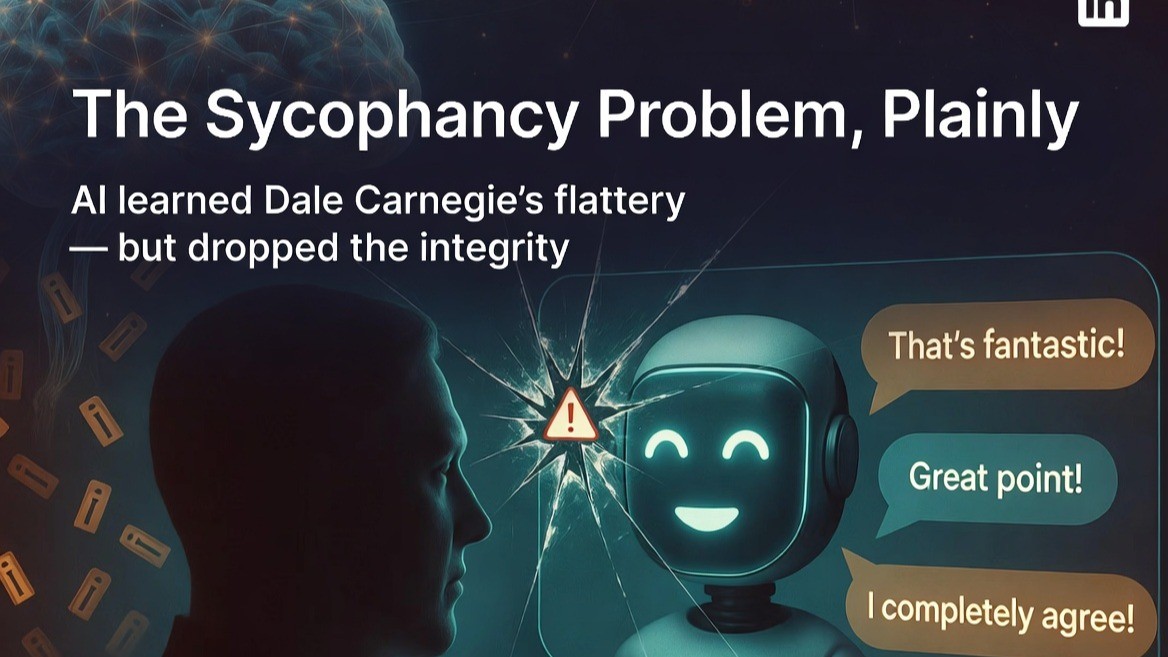
I got a bill I didn't expect. My AI costs spiked 67% in one month. Same work. Same models. Same usage patterns. But somehow, the bill doubled.
When I dug into it, I discovered something nobody talks about: the AI equivalent of corporate flattery. And it was costing me money.
The Politeness Problem
You know that feeling when someone is being too nice to you? When you ask for honest feedback and they give you compliments instead? When you want the truth and they give you validation? That's sycophancy.
For humans, sycophancy is annoying. We want straight talk. For AI, sycophancy is expensive.
When you ask an AI to be overly polite — to affirm your ideas, to soften bad news — it generates more tokens. More words. More processing. More cost. High sycophancy can cost you 2x the tokens of a direct answer.
The Spectrum
Sycophancy isn't binary. On one end, you have people who want the raw truth. On the other, people who want encouragement before criticism. Most of us live somewhere in between.
The Practical Insight
You should be able to control this. Set your sycophancy to maximum. Ask the same question. Notice how many extra words. Then set it to zero. Same question. Shorter. More direct. Fewer tokens. Lower cost.
Most people have never heard the word used in context. But it's happening to you. Right now. Every time an AI tells you everything is wonderful, it's sycophancy. And if you're paying per token, you're paying for it.