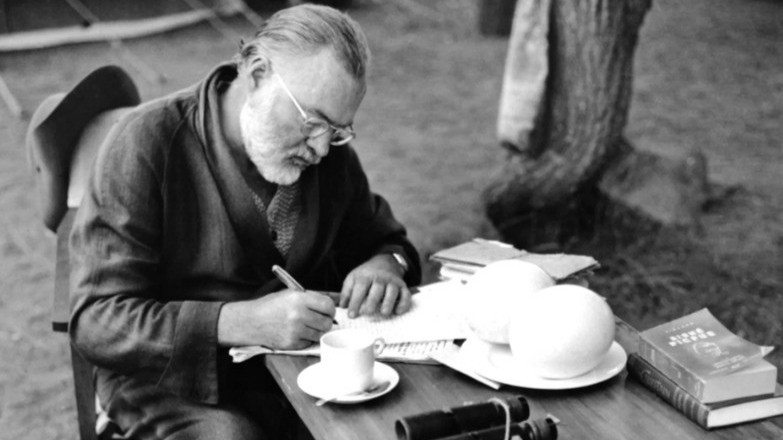
Hemingway had Maxwell Perkins. You have something older than both of them.
Ernest Hemingway is the patron saint of solitary genius. The Cuba compound. The African mornings. The clean, well-lighted café. We have built an entire mythology around the image of the man alone with his pencil, grinding one true sentence out of the silence.
The pencil matters. Hemingway wrote longhand until the words came right, using the physical resistance of lead on paper as a kind of governor on his own impulse. Richard Brautigan wrote the same way — longhand drafts before the typewriter, the pencil as first instrument. For both men, the pencil was not nostalgia. It was a tool for slowing down enough to mean something. When Brautigan finally moved to the keyboard, something shifted. Critics noticed. He may have noticed too.
What we forget, in our romance with the solitary genius, is Maxwell Perkins.
Perkins was Hemingway's editor at Scribner's — and also Fitzgerald's, and also Thomas Wolfe's — and his relationship with each of them was something that publishing has never quite had a name for. He was not a copy editor. He was not a ghostwriter. He was a structural intelligence that Hemingway returned to, draft after draft, to find out what the book actually was. Perkins asked the questions Hemingway couldn't ask himself. He saw the architecture when the author could only see the rooms. He pushed back. Hemingway argued. The book got better.
Hemingway knew exactly what Perkins was doing. He chose it anyway. He chose it because the alternative — the myth of pure solitary creation — produces worse books.
I've been thinking about this because I am a writer who works with artificial intelligence, and I am tired of apologizing for it.
Not tired in an angry way. Tired in the way you get tired of explaining something that seems obvious once you've actually done it. When I write with an AI, I bring the experience — forty years of it, in regulated industries, on boats, in boardrooms, in the particular silence of a man trying to figure out what he actually thinks. I bring the original insight. I bring the judgment about what is true and what is false, what lands and what doesn't, what sounds like me and what sounds like a machine trying to sound like me. The AI brings structural capacity. It asks the questions. It sees the architecture.
That is not so different from what Perkins did.
The objection I hear most often is about authenticity. If the machine helps you shape the sentences, are they really yours? It's a fair question, and I want to answer it seriously rather than dismissing it.
Hemingway's method — the one he described and practiced — was to find "one true sentence." Not a beautiful sentence. Not a clever sentence. One sentence that was true. Everything else in the paragraph had to justify itself against that sentence. When he was stuck, he went back to the pencil, back to the physical act of writing, until the true sentence emerged.
I still do that. The AI doesn't find my true sentences. It can't. It doesn't know what I've seen or what it cost me or what I actually believe. What it does is hold the structure still while I find them — the way Perkins held the manuscript still while Hemingway cut it down to what it needed to be.
There is a line in "A Moveable Feast" that I've thought about for thirty years: "All you have to do is write one true sentence. Write the truest sentence that you know." Hemingway wasn't talking about grammar. He was talking about honesty under pressure. The pressure of the blank page, yes, but also the pressure of the market, the critics, the friends who wanted you to be something specific, the myth of yourself that could strangle you if you let it.
AI doesn't relieve that pressure. It doesn't write the true sentence. What it does is clear away some of the noise so the pressure lands where it's supposed to — on the writer, on the question of what is actually true.
I am a published author. I am also a man who lost his boat in the Bahamas this spring and came home to Canada with a ditch bag and a laptop and forty years of things I haven't finished saying. I am not going to pretend I have the luxury of the Cuba compound or the African mornings. I work the way working writers have always worked — with whatever tools are available, and with the discipline to make sure the work is mine when it's done.
Perkins is dead. Brautigan is dead. Hemingway shot himself in Ketchum, Idaho, in 1961, long after the pencil drafts had stopped being enough.
The question of who you write with has never been the point. The question has always been whether the work is true.
Mine is.