I wasn't prepared for the fatigue that set in on the short subway ride back to the apartment near Victory Park. Every symbol on every sign is cryptic and the noise of the Cyrillic characters drowns out the English words, which if noticed, simply tease with partial information. They are another puzzle masquerading as a solution to me. "Number 2 line, one stop, Ring line, one stop, red line, one stop, down Gagarin Street, turn right, go to number 3."
The subway is rushed. Russian politeness means taking the next place in line. Yield means nothing, and when a train disgorges its rushing hordes, I have to stop my puzzle-solving, duck into an alcove, and try to reconnect with whichever side of my brain I use for puzzle-solving. It is a fair distance from the side that runs from the subway's rushing hordes. The pun fits so well today.
The subways are decorated in what I think of as traditional Soviet art — mosaics and portraits of serious workers, sometimes taking time out to release a white dove, and under the watchful eye of Lenin at the place of prominence at the end of the platform.
Moscow Subways Are Simply Spectacular
In the last three weeks I have been in four world-class capitals. I returned to London after a 42-year absence. London is a noisy city and a very dangerous one. While riding in the famous London cabs, I realize that the white lines in the road are simply suggestions. In five days in London, I don't get the hang of massive traffic on the wrong side of the road. I almost join generations of road kill twice before I hear a father say to his eight-year-old son, "OK, follow the green man" — referring to the pedestrian walk light. I was last in London as an eight-year-old and perhaps this is a coincidence, but I took the advice in London and remembered it in Moscow, where white lines on the road are not even vague suggestions but challenges to drivers to find, and hold, a place in the road.
I was standing in Trafalgar Square trying to remember an eight-year-old standing there 42 years ago. "Where did I stand?" "Did I climb on the lions?" "Where did all those aggressive pigeons go?" I could not connect across the years but I knew that I should have been able to.
Then I walked around. I walked around the Admiralty, which sent out Cook, and Raleigh, and Vancouver and Bligh to adventures I'd read about since. I walked through the Horse Guards, who launched the massive land wars against Napoleon, and the relatively puny but successful defence of Canada in 1812. A tip of the hat as I pass Canada House, and then I am ready to salute the multicultural city that London has become — with a glass of white wine and salad at an Italian restaurant across from the Horse Guards, a couple of local British ciders, an ice cream cone from a street vendor, and courses of Lebanese delights in four different establishments in the Edgware Arab quarter on the long way home.
I had ridden the double-decker bus down Piccadilly Road, sitting in the very front with the huge window offering so much to see. On the high bus ride to Trafalgar, I had noticed the Hard Rock Café — the t-shirt shop that solves a lot of problems when bringing home gifts for kids. It is humbling to acknowledge some things we fear, like choosing gifts, and I am prepared to make a pact with the commercial devils to face such fears.
On the way back I'm looking down from the double-decker bus at the fences that surround Green Park, and these fences suddenly erupt into a ribbon of colour. The street merchant's cheesy enthusiasm of colour turns from flags to t-shirts to posters and starving-artist art, and it was the sombre stretch of old brown books that prompted me to leap up and descend from the bus.
I did three passes of the bookseller's wares and each time I passed his van — within its chess board and half-played chess game — I discovered he was Polish, friendly, and had hidden gems among the ratty pocketbooks: a French book of lyrics; an Arabian tale; a copy of Tom Brown's School Days; a book of Irish tales, all well over one hundred years old, and one from 1815. They were all gifts, and each one perfect for my victims.
The prices, pencilled in on the inside covers, totalled 26 pounds. I approached his van parked in the curb lane on Piccadilly Road. He was pushing seventy. He was busy chatting in Polish to two ladies and I sat in the vacant chess opponent's chair and waited. He sat down across from me, this elderly man with so many stories not of his own. I stuck out my hand, shook his, and told him, "You have the best shop in London, thank you!" He smiled and said, "Thank you, but the Council wants to shut me down." And then: "You look like you are in trouble" — gesturing to the chess board. He shrugged and said that this game would never be finished. "Would you like to play?" We had exchanged our compliments and gentle softening up of each other. I had to decline. I had no time.
I handed him the impossibly big stack of four books. "I would like to offer you twenty pounds for your fabulous books." He smiled. He beamed. I thought: if he thought I was Canadian he is in doubt now. He carefully opened each cover and added the prices. "That is very low." He smiled. "Yes, perhaps. They are wonderful books." "I could let you have them for twenty-three pounds." I stuck out my hand: "This is the best shop in London." Our first dance over, I asked him if he had any cookbooks from the previous century. He found the uninteresting one on fish, and then pulled out a general cookbook from 1885. The cover price was six pounds. The now-familiar dance begins. "I would like to offer you four pounds." And of course we are both happy to agree at five.
It is a bright spot before I walk the half kilometre to the brightly lit darkness of the Hard Rock t-shirt shop.
I recall, at some point in my travels that day in London, a moment of incredible sadness. I watched couples walking around and sharing the monument at Trafalgar. Two young lovers spooned on the back of one of the massive lions. Other couples walked hand in hand. Groups of young teenage girls giggled and posed for their cameras, always with one of them not in the picture, relegated to obscurity by some Darwinian social order — until digital cameras and democracy meant that images were cheap and plentiful and everyone took turns being the one left out.
A week later, in Amsterdam, I did not have this happen, and I was grateful to my friend and guide Anna for leading me around her city and sharing her fondness for it. The flirting we did on the trip kept my feet and heart light, and the brief tsunami of grief that happened in London did not trouble me in the least in Amsterdam.
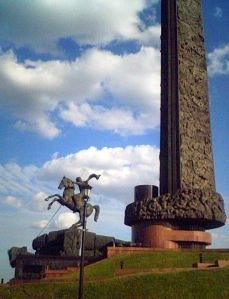
Now, thinking about that here in Victory Square, I wonder how I feel about it in Moscow. Victory Square is full of couples. Russian girls are impossibly thin, poised, and self-important. Their boyfriends are playthings and they dote happily. The Square is a continual reminder of the frigid brutality of the conflict of World War II. The monuments are massive. A colossal building curves around the central monument and cups the centrepiece tower, almost tenderly. The dark angel at the top of the lofty tower holds a victory wreath over the struggling brave masses of people who were sent into the grist. Many were unprepared to do much more than use up the resources of the German war machine, one bullet at a time.
The tower is busy with carved inscriptions that I cannot read, but presumably are the names of towns — many long erased — where heroes of Russia gave up their lives to stop the German army at the gates of Moscow. A lone rider drives an impossibly long lance into the neck of a broken dragon with swastika emblems on its side.
The long row of fountains provides a palace for skateboards and roller blades to carry their couples and their serious groups of teenage boys and girls who are alone, but together, on the wide and impossibly long parade. It seems that only I walk alone. The roof of one massive bell tower gleams in the late afternoon sun. There is a sea of red — but ironically, it is a sea of red Coca-Cola umbrellas, chairs and tables in front of the beverage vendors — and I think of the millions who died, ground up in a war for survival where so many did not survive.
As I sit alone and watch all of this, I have an unkind thought: that Moscow is not a city for lovers. And I have no hint of the London-style wave of sadness at not being able to share such an experience with a lover.