How I Think About Momentum and Cultural Emergence
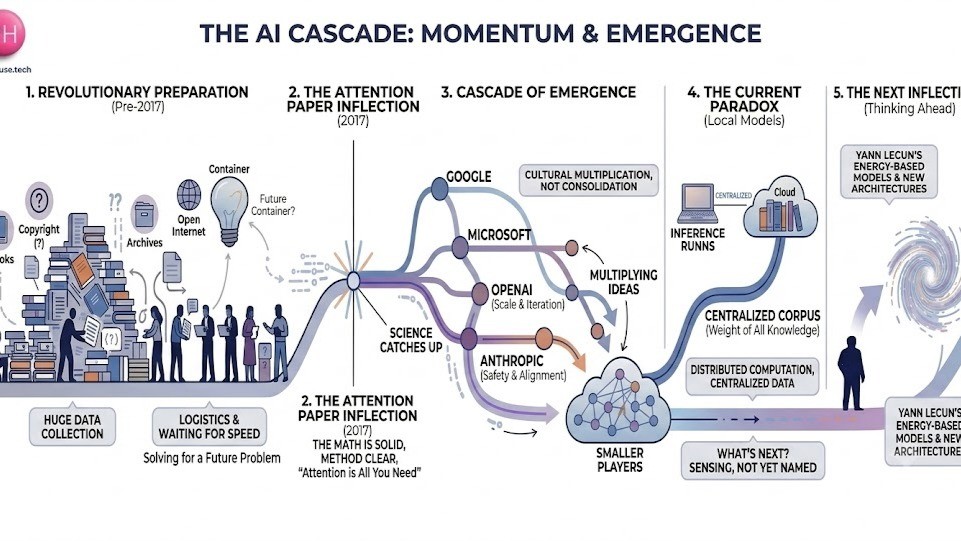
The brave part—the part that happened while the world wasn't watching—was committing to a massive data collection without knowing what container would eventually hold it. Books were gathered. Copyright became a question mark. Datasets assembled from archives, museums, the open internet. The logistics of moving all of that into storage, organizing it, waiting for the machine that would be fast enough to process it. That's different than solving a problem. That's solving for a problem you haven't yet built the answer to.
Then, nine years ago, something locked in. 2017. The Attention paper. Suddenly science caught up to the ambition. The method was clear. The math was solid. You had the data. You had the frame. You had the computational path from input to output. That moment changed everything that came after it.
What followed wasn't one company winning. It was a cascade of emergence. Google made a move. Microsoft saw it and moved. OpenAI showed what you could do with scale and iteration. Anthropic emerged with a different thesis on safety and alignment. And then all the smaller players. Each one watching what the last one built and thinking: I can do that, and differently. The cultural moment was one of multiplication, not consolidation.
Now there's talk of AI on your laptop. Local models. On your computer. Which is curious, because you can't fit the data there. Not really. So what we're actually building is a paradox: the inference runs locally, but the weight of all that knowledge—all those books, all those texts, all those patterns—lives somewhere else. We're distributing the computation while keeping the corpus centralized. It looks like independence. It's really just a different kind of outsourcing.
What's next? Yann LeCun is thinking about it. Energy-based models. Something we haven't seen yet. A different architecture, a different frame. He's not publishing much yet, which is the right thing to do when you're still thinking. But he's watching, and the field is watching him. Because nine years after the inflection, we don't know what the next one looks like yet.
That's how I think about it. Not as a series of victories or crashes. As a cascade of emergence, rooted in a data collection nobody rushed, locked by an inflection we can now see clearly, and now reaching toward something we can sense but not yet name.