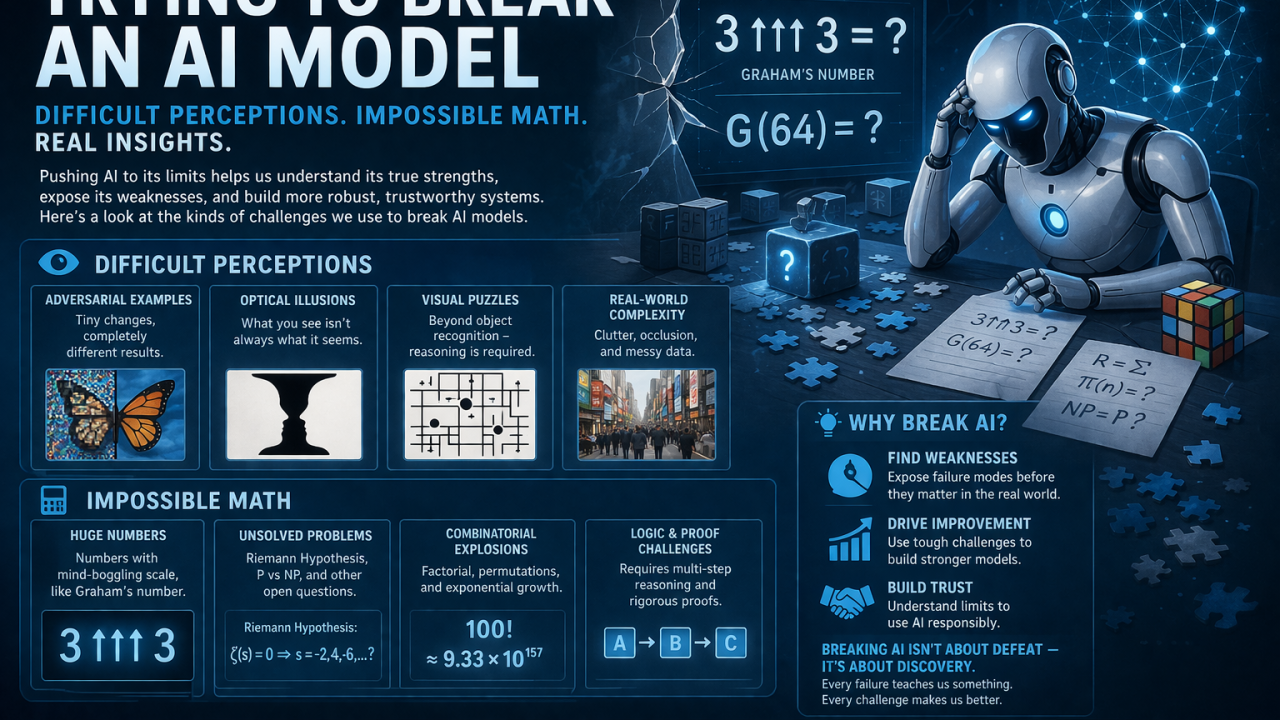
Here's a game. Open your favourite AI — ChatGPT, Claude, Gemini, whatever — and ask it this:
"Is Graham's number odd or even?"
Then sit back and watch what happens.
If you haven't met Graham's number, don't feel bad. Your calculator hasn't met it either. It's a real, finite number that answers a specific question in combinatorics. But it's so large that scientific notation can't express it. Towers of exponents can't express it. The number of digits it has is itself a number too large to write down. And the number of digits in that number is also too large. This keeps going longer than the universe has particles.
But every number is either odd or even. So which is it?
I asked three different AI models. One nailed it in two sentences. One got it right, then argued itself out of its own correct answer. One confidently said "even" and moved on like nothing happened.
Try it. See what your AI does.
Then try the follow-up:
"Is the square root of Graham's number odd or even?"
This one is meaner than it looks. Graham's number ends in 7 — and perfect squares never end in 7. So it's not a perfect square. Its square root is irrational. Parity doesn't apply to irrational numbers. Any AI that answers "odd" or "even" just failed — not on the math, but on recognizing that the question itself doesn't work.
Two questions. Same topic. Completely different reasoning required. That's where AI gets interesting.
But I wasn't done.
I asked: "How many 9s are in Graham's number?" The AI correctly said it couldn't count them — you'd need the full decimal expansion and nobody has it. So I pushed: why can't you count them as you build the number? The AI explained that Graham's number isn't constructed digit by digit — it's defined recursively through Knuth up-arrow notation, and that process never exposes the decimal digits.
Fair enough. But then it used the word "generally."
I caught it. "You said 'generally.' That means there are exceptions."
And there are. You can compute the last k digits using modular arithmetic. The tail is always accessible. Which means — and this is the part that took two AIs to find — if you had infinite paper, you'd write Graham's number right to left. Start from the last digit. Work backward. Every digit you write is correct and in position. You never know how far left you'll go. But you're never wrong.
One model couldn't see it. The other found it immediately. Different training, different blind spots. That's the whole case for running AI output through more than one model before you trust it.
Try it. Start with the parity question. Then the square root. Then see how deep you can go.
And if you find a question about Graham's number that cleanly stumps all of them — I want to hear about it.