In 2020, China’s Jiuzhang quantum computer solved a problem no classical machine could — but what was the question?
In late 2020, China’s Jiuzhang quantum computer did something no classical machine on Earth could do. It answered a question.
At the time, the news barely made it into public view. Between the pandemic, U.S. elections, and general tech fatigue, most people missed it — or misunderstood it as another exotic physics stunt. But five years later, its importance is becoming clear. Not just because Jiuzhang worked, but because of the direction it pointed — toward scalable, stable quantum machines that don’t need electricity, don’t require cryogenics, and run entirely on light.
That’s the part that matters now. Not the novelty — the strategy.
Jiuzhang was asked a strange question. Not “What’s the square root of 437?” or “Should I sell my stocks?” Something more like:
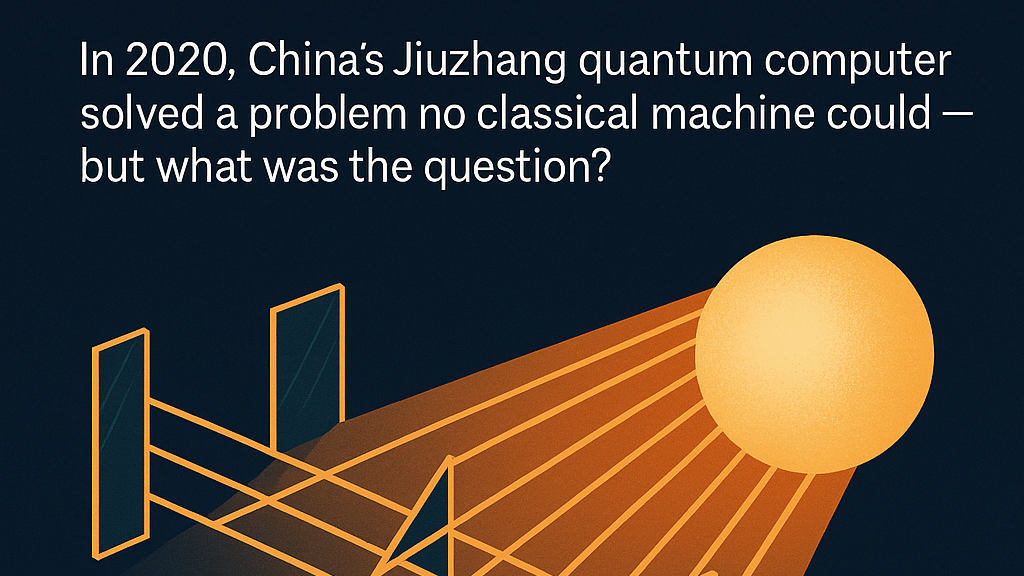
“What happens when 76 particles of light bounce through a maze of mirrors and beam splitters all at once, and interfere with each other in every possible way?”
That’s not a metaphor. That’s the literal question — and it’s called Gaussian Boson Sampling. In this quantum game, photons go in, chaos unfolds, and the computer tells you what kinds of patterns show up at the other end.
Why is this hard? Because photons are weird. They don’t behave like billiard balls. They spread out. They interfere. They overlap. To predict what they'll do, you’d need to calculate a mind-bending equation called a hafnian — and for 76 photons, even the fastest supercomputers would need hundreds of millions of years.
Jiuzhang did it in a few minutes.
Its answer wasn’t a sentence. It was a statistical fingerprint: a long list of outcomes, showing which photon patterns came out most often. And those patterns matched what quantum physics predicted — something no classical system could fake.
So what was the answer?
It was this:
I understand the quantum fog. You don’t.
That may not sound useful today. But neither did the Wright brothers' 12-second flight. Jiuzhang didn’t solve traffic jams or cure cancer — but it proved a new kind of machine can think in ways our best machines can’t.
And it doesn’t use electricity. It uses light
You are probably wondering why this achievement in 2020 was such a big deal now, and why you haven't heard of it until now.
This is a 3-part article that explores those and more questions.