I’ve built three call centers—going from low tech trenches to high tech, multi-skill environments. I’ve watched them soar, and I’ve watched them crash. My worst crisis wasn’t political. It was technical. A simple errant character in a SQL upgrade corrupted our tables, hardware failures compounded the chaos, DASD crashed… suddenly, our phones wouldn’t stop ringing. For two grueling weeks, our IT department fought fires so we could keep the company and our clients afloat.
But here’s the thing: our people rose, not wilted. They faced panicked callers, shifting rules, system meltdowns, and they did it with energy. Franca Casalinuovo, our call center and office manager, was the heart of that calm in the storm. If FEMA is looking for leadership today, they need Franca.
FEMA’s Collapse: July 5 to 14, Revisited
The flooding began between July 5 and July 6, submerging homes, washing out bridges, and overwhelming local emergency resources just as FEMA’s staffing and systems were unravelling.
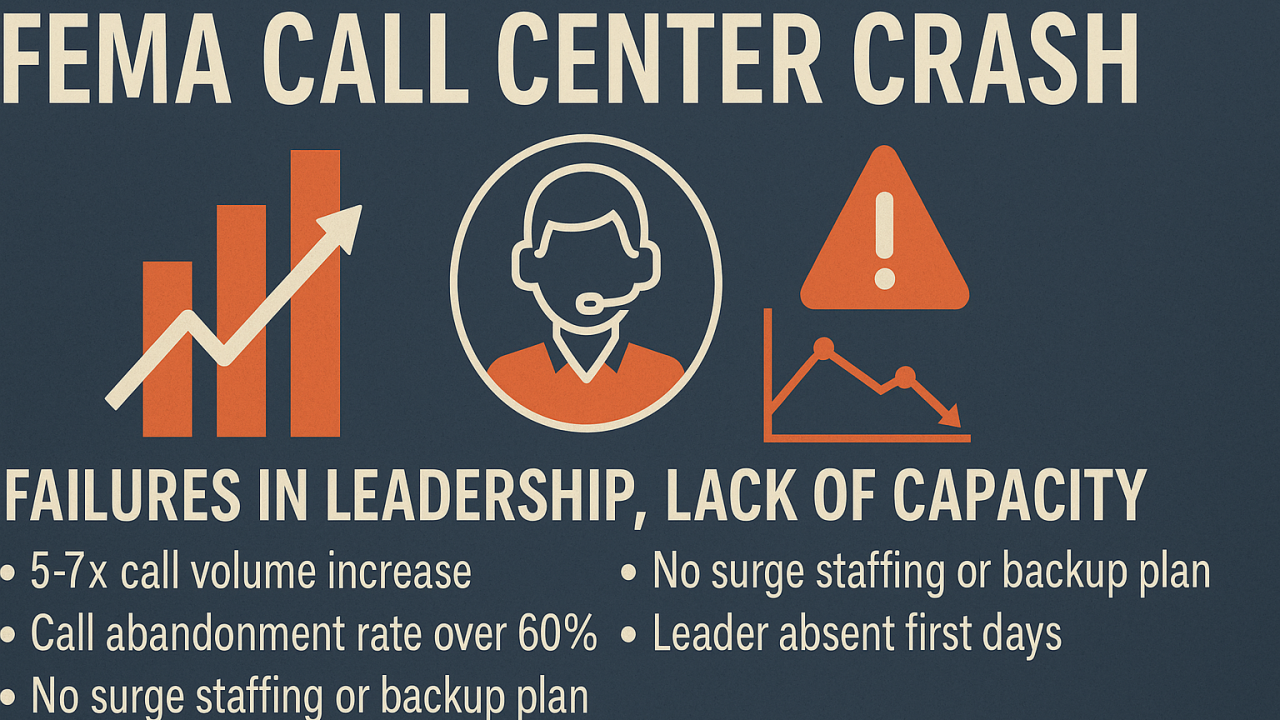
July 5: FEMA answered 3,027 of 3,027 calls, the final day before everything unraveled.
July 6: Answer rate crashed to 36%—1,517 callers lost.
July 7: Disaster struck—16,419 calls, only 2,613 answered (~16%).
Contracts weren’t renewed until July 10, after Secretary Noem’s personal sign-off requirement—a week too late.
That staffing gap had catastrophic consequences.
Who Was at the Helm?
The FEMA failure didn’t happen in a vacuum. It reflected a style of top-down micromanagement and expertise suppression that has come to define the Trump administration’s second term. Centralized authority, limited delegation, and political appointees with little relevant experience have become standard.
Kristi Noem, now Homeland Security Secretary, had no prior call center or emergency management experience. Yet she introduced a new rule: all FEMA contracts over $100,000 required her personal approval. That rule delayed the reactivation of FEMA’s call center contractors.
David Richardson, FEMA’s acting administrator since May, also lacked experience in natural disaster response. A former Marine and WMD specialist, he was absent from the command center and did not appear in Texas until July 12—a full week after the peak collapse. His delayed response and lack of relevant experience were noted across media and government channels, raising widespread concerns about FEMA’s leadership capacity during crisis.
Meanwhile, dozens of talented individuals—several levels down—who could’ve solved this crisis were sidelined. That echoes a broader trend under this administration: flattening expertise and funneling decisions upward into a culture hostile to on-the-ground professionals.
Layoffs, Attrition, and Eroded Capacity
In early 2025, approximately 200 FEMA employees were laid off. Over 2,000 more departed through buyouts or attrition. By July, FEMA was operating with a workforce more than one-third smaller than it had been at the start of the year. So even before the contract expiration, FEMA was already undermanned and structurally brittle.
Estimating FEMA’s Call Center Capacity
July 5: If 3,027 calls were handled in an 8-hour shift at roughly 10 calls/hour per agent, that’s about 38 agents on duty.
July 7: That same group—around 35 to 40 agents—was overwhelmed by a 7× call surge.
There was zero surge capacity—no backup pool, no cross-trained teams, no automated routing fail-safes. A disaster was coming, and FEMA let the front lines collapse.
Don’t Forget the Mud, the River, the Real People
While Washington dithered, the people of Texas suffered. Knee-deep in mud, some watched bodies float by. Local volunteers and church crews did what FEMA wouldn’t or couldn’t.
And one more thing: Mexican search-and-rescue volunteers, including trained professionals and skilled civilians, crossed the border to offer help unprompted. Multiple credible eyewitnesses and local reports confirmed that some of these Mexican volunteers were turned away or detained by U.S. border agents—a disgraceful turn of events by any standard.
But many stayed. Quietly, anonymously, they dove into those waters to help strangers.
Let’s not confuse bureaucratic failure with a lack of heroes.
What This Teaches Us
1. Preparedness doesn’t just happen. It must be designed into contracts, staffing, systems. 2. Flattening expertise is perilous. Centralizing approvals costs lives when every minute counts. 3. Layoffs erode readiness. They culminate in a hollow agency stripped of mission-critical capability. 4. Call center staff are your front-line heroes. FEMA buried that talent beneath layers of bureaucracy. 5. Silence is a form of harm. When the call doesn’t go through, hope dies a little. Ask anyone who’s waited on hold in the dark after a flood. 6. Leadership absent from the field is not leadership at all. When you're not there, you can't feel the mud, the chaos, or the courage.
Is FEMA Back on Track?
As of July 14, FEMA was still missing roughly two-thirds of calls. Contracts were only signed on July 10, and even then, it takes days to staff up, train, test systems, and restore performance. FEMA wasn’t “keeping up”—they were descending and slowly clawing back, still far from pre-flood readiness by July 14.
Final Word
FEMA didn’t crash on July 7—they were already falling apart long before. It was built into policy, layoffs, and leadership overload. And it was front-line professionals—like Franca—who kept picking up the pieces.
If we ever want a FEMA that actually responds, we need leadership that trusts expertise, not news cycles; policies that embed surge capacity, not bottlenecks; and people empowered to answer the call—even under fire.
And we need to remember the ones who showed up. Not for credit. Not for pay. But because someone needed help in the river.