There are two ways to fail at writing with AI, and they sit at opposite ends of the same mistake.
One: walk up to the AI, ask for twenty thousand words of swords and dragons, or a Dracula love story, and call the result a book. Fifteen words in, a manuscript out. That is not writing. I would not put my name on it, and I would not be proud of it if I did.
The other: refuse the tool altogether. Quill pen, blank page, Dickens by the word, on principle. That is not virtue either, it is just a different kind of vanity. Len Deighton is supposed to be the first novelist to write a bestseller on a word processor. Whether or not that is literally true, the lore makes the point: the tool was never the thing that made him a writer. The decisions were.
So if both extremes are wrong, what is the actual line between an ethical writer using AI and a counterfeiter dressed as one? It is not how much AI touched the page. It is how many places a human stood and decided to let something stay or go.
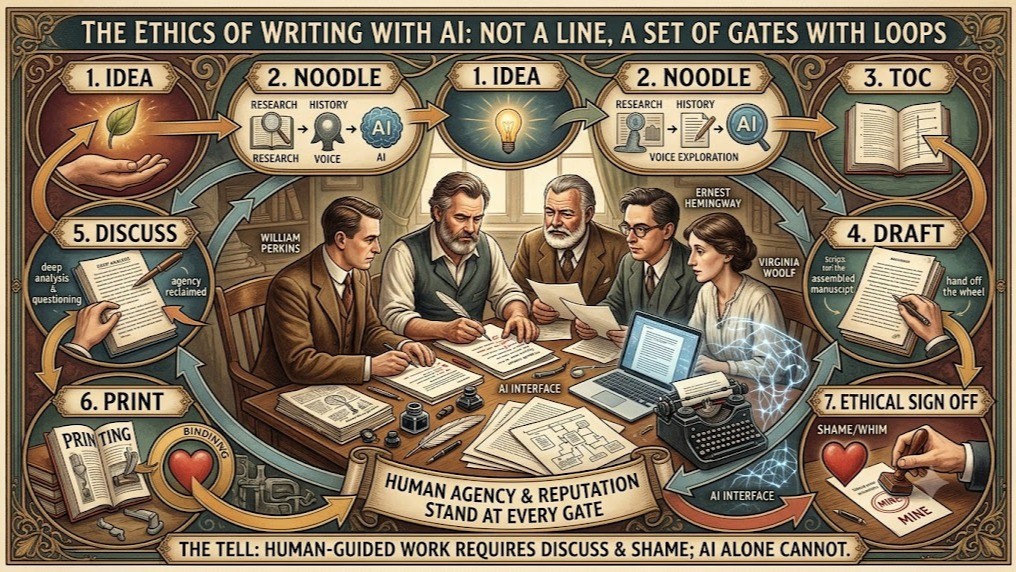
I work in seven stations, not steps, because steps imply a line, and this is not a line. It is a set of gates with loops between them.
Idea. Has to start with me, because nobody else has the stakes.
Noodle. The most important station, and the one most people skip entirely. This is where I ask for history, for examples, for opinions I am free to reject or accept. The AI earns its keep by bringing back things I did not already have in the form of history, acts and perspective. Voice gets decided here too, before architecture, because everything downstream is built to carry a sound. Every musician assembles the shape of their sound by selecting instruments, techniques and the mechanics of their voice. This is the same thing.
TOC. The architecture. Chapter headings, sub-chapters, the shape of the thing.
Draft. The one station where my hand comes off the wheel. I have made every decision up to this point, and now I watch the first draft assemble.
Discuss. The hand goes back on immediately. I read what came back and ask why this phrase, why this order, push on what is weak. Draft and Discuss look like a single step from a distance. They are not. They are opposite postures. I had suspended agency and then recaptured my agency in full force. That is exactly why they need separate names. The riskiest action an author can do is to sleep through this discussion phase. You can lose the writing or keep control.
Print. This is a mechanical process, except when it is not, because rereading the finished thing can send you all the way back to Idea.
Ethical Sign Off. This is not a review, because review has already happened at every gate. Sign off is the moment I stop looping on purpose and decide the thing is mine.
That last gate is a feeling I have been calling “whim”. It is the flinch where I determine that I do or do not want my name on this. It is not arbitrary, it is forty years of writer’s taste firing too fast to feel like reasoning. Underneath it is something simpler: shame which is the capacity to be embarrassed by your own page. An AI can produce text that performs stakes, memory, intent, restraint. It cannot have shame, because shame requires something to lose, and AI has no reputation sitting on the other side of a bad sentence. That is the whole argument that supports the Sign Of which keeps the piece human. It is the one station nothing else can stand in for. Only I can own it.
The loops are not fixed radius. Discuss can kick back one station to Draft, for a paragraph. It can kick back to Noodle, for a restructure. It can kick all the way back to Idea, Sign Off says start over, and you go once more around the merry go round.
None of this is about purity. I take shortcuts inside this process, plenty of them. The test was never whether AI helped. The test is whether I can point at every paragraph, every word, and say I decided to choose it. It would not exist without my giving birth to it.
Here is the tell, if you want one number to carry the whole argument. This article ran many thousands of words of conversation to produce the eight hundred you just read. The other kind of book runs fifteen words in and twenty thousand out.
One of those numbers required a human standing at the gate the whole way through. The other required fifteen words and nobody home.
This is a hotly contested topic and I expect to hear acceptance and rejection and that’s ok. AI has changed many of the capabilities in writing, but I am still here, guiding the work.
Did I choose a style like Hemingway’s iceberg, Pynchon’s maximalism, or Woolf's stream of consciousness?
In this argument, it is worth reading about William Perkins, who rewrote many famous author’s books and gave them style and direction without proper credit. He died in 1947 and yet still lives in this discussion of how to use AI to help in writing.
I’ll let you discover how.