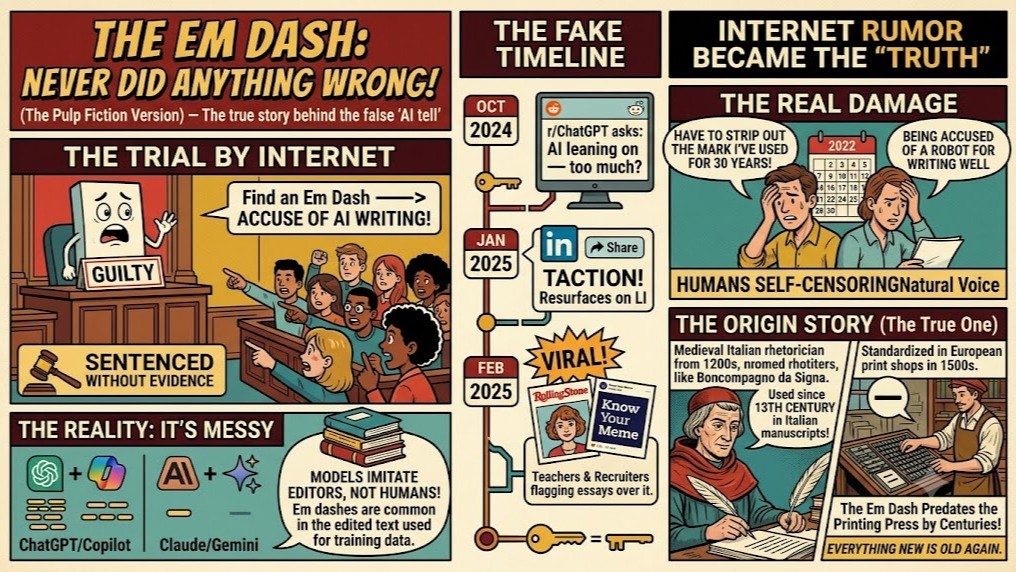
The Pulp Fiction Version
Somewhere in the last eighteen months, a punctuation mark got put on trial, found guilty, and sentenced without a single piece of real evidence ever entering the record. That's not a metaphor. That's the actual story of how the em dash became internet shorthand for "this was written by AI," and almost nobody asking the question has checked whether it's true.
Here's the timeline, traced back as far as anyone can find it.
October 2, 2024. A now-deleted post on r/ChatGPT asks whether anyone else has noticed ChatGPT leaning on em dashes constantly. The replies push back. Plenty of humans write that way too, several point out. The observation sits there, mostly ignored, for months.
January 2025. The claim resurfaces on LinkedIn, gains traction, gets shared, gets argued about in the comments. It's still a niche observation, but it's no longer contained to one subreddit.
February 11, 2025. A post goes properly viral, framing the em dash as a simple tell, a symbol that supposedly gives away AI-written text on sight. Within days the idea has a name, the "ChatGPT hyphen," and a life completely independent of whether it's accurate. Rolling Stone covers it. Know Your Meme catalogues it. Teachers start flagging student essays over it. Recruiters start side-eyeing resumes over it.
Nobody, at any point in that timeline, ran the actual test before declaring the verdict.
When people finally did test it, the picture got messier, not cleaner. Some models do lean on the em dash heavily. Others barely touch it. One side-by-side comparison found ChatGPT, Copilot, and Deepseek using it constantly, while Claude used it twice in an entire generated article and Gemini didn't use it at all. A punctuation mark that one major model avoids almost entirely isn't a signature of "AI writing." It's a signature of one specific model's training data, at best.
And the training data explanation is the part that actually holds up. These models learn what "good writing" sounds like from the text they're trained on, and that text skews heavily toward edited, professional prose: journalism, published books, corporate copy, the kind of writing where em dashes show up constantly because professional editors reach for them as a flexible, all-purpose connector. Ordinary human writing, texts, emails, forum posts, voice notes, uses them far less. The model isn't impersonating a human. It's impersonating an editor. Mistaking that for proof of authorship is like accusing someone of being a robot because they know how to use a semicolon.
The real story underneath the meme was never about a horizontal line on a page. It was about a much less comfortable fact: most people genuinely cannot tell AI-written text from human-written text anymore, and that's an unsettling thing to sit with. The em dash gave everyone a cheap way to feel certain again. Spot the mark, declare the verdict, move on. Never mind that the rule was wrong more often than it was right. Certainty was the product being sold, not accuracy.
There's a cost to that certainty too, and it landed on real people. Writers, journalists, anyone with an MFA or a few decades of using the mark correctly, started getting accused of being a chatbot for writing the way they always have. Some started stripping the mark out of their own work pre-emptively, editing their natural voice to dodge an accusation built on nothing. That's the actual damage here: not that AI uses a punctuation mark, but that humans started self-censoring a perfectly good piece of grammar because a rumor outran the fact-check.
The em dash didn't do anything. It never lied, never fabricated a citation, never hallucinated a source. It just sat there, doing the job punctuation has done since long before any of these models existed, while an entire internet decided it was the smoking gun in a case that was never actually built.
If you're looking for where AI text genuinely gives itself away, the researchers who study this for a living point elsewhere: word frequency patterns, an unnatural absence of typos, a kind of relentless evenness that real human writing rarely has. None of that fits in a meme. A horizontal line does. So the line took the fall instead.
Which brings us to the part of this story nobody bothered to look up before starting the trial.
The Origin Story
The em dash is not a product of the digital age. It is not a creature of Microsoft Word, or the internet, or AI. The earliest ancestor of the mark, a horizontal stroke used to signal a long pause in written text, shows up in a 13th-century Italian manuscript. Boncompagno da Signa, a rhetorician working in Florence around 1200, called his version the virgula plana. He used it as a punctuation tool centuries before movable type existed.
When European print shops began standardizing their type cases in the 1500s, the dash arrived as a practical solution: something longer than a comma, less formal than a colon, flexible enough to carry the connective load between ideas that didn't quite fit any other mark. It spread shop by shop across Italy, England, and the continent, with no single inventor and no founding document. It just worked, so it stayed.
By the 1600s and 1700s, the mark was a recognized tool of English prose. Laurence Sterne, writing in the 1760s, leaned on it so heavily that readers started noticing it as his style. He didn't invent it. He just loved it more visibly than most.
That's the mark that got put on trial in 2024. It is not a novelty and not a symptom of evil. Something that has been doing useful work in the written language for eight hundred years, outlasting every empire, every printing technology, every literary movement that tried to clean up the language and failed.
Everything new is old again. The panic is fresh. The punctuation predates the printing