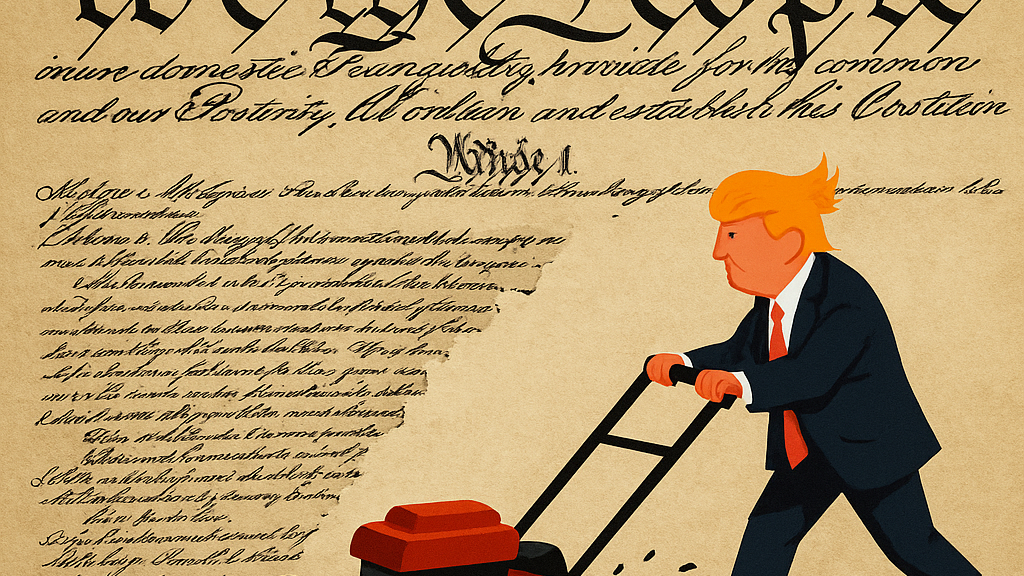
I. Introduction: What They Didn't Teach You in Civics The U.S. Constitution was never designed to run on autopilot. It depends on participation, enforcement, and good faith. But in 2025, it’s being bent, bypassed, and reinterpreted in ways the Framers never imagined. Not rewritten—just hacked.
This isn’t a theory. It’s not an academic warning. It’s happening, right now, in real time.
Some Americans assume the Constitution is self-executing. Others don’t know what “separation of powers” or “habeas corpus” mean. And that’s not their fault. But it’s also not safe.
This isn’t just about Trump. It’s about the weak points in the system, and what happens when someone tests every single one of them at once.
I.a. Why the Constitution Still Matters The U.S. Constitution is not just the blueprint of American governance, it’s the heart of American identity. No other modern republic has operated this long on a single founding document.
It’s been amended, debated, tested, and stretched, but never replaced. And for 250 years, it has outlived empires, weathered civil wars, and guided generations through uncertainty.
It’s the most ambitious civic experiment in human history: a bet that power could be distributed, that rights could be defended, and that government could be held accountable by law, not by force.
It doesn’t just protect citizens. It protects everyone inside the borders of the United States—citizens, non-citizens, even people Trump labels as enemies or threats. That’s not a loophole. That’s the point. Constitutional rights don’t require a passport. They require presence. And when a president ignores that, it’s not just a policy breach. It’s a constitutional violation.
Without this framework, there is no "America" as we know it. Not a republic. Not a system of checks and balances. Not a safeguard against tyranny. If that framework is lost, then America becomes something else. Not instantly. But inevitably.
II. What Separation of Powers Really Means The Constitution splits federal power into three branches:
Legislative (Congress): Makes the laws
Executive (President): Enforces the laws
Judicial (Courts): Interprets the laws
Each branch is meant to check the others. No single person should be able to make, enforce, and interpret law alone. That’s the core operating principle of the republic.
But when one branch refuses to check another, or when a president builds loyalists across all three branches, that separation can fail silently. And once it does, it doesn’t matter what the Constitution says. Power goes to whoever uses it.
III. The Disappearing Due Process: Habeas Corpus in Real Time Habeas corpus is a legal principle that says you can't be imprisoned or detained without being brought before a judge and told why.
It’s not optional. It’s one of the few rights written directly into the Constitution itself (Article I, Section 9). It was once suspended during the Civil War, briefly.
Today, under Trump’s DHS and ICE orders, people are being arrested without warrants, held without judicial review, and deported despite active court orders. Some aren’t even immigrants.
That’s not politics. That’s a constitutional suspension happening by practice, not decree. And the longer it happens without pushback, the more it becomes precedent.
IV. The Modern Hacker: How Trump Slips Past the Guardrails Trump’s superpower isn’t legal knowledge. It’s daring.
He moves faster than the system is built to respond. He dares courts to stop him. He dares Congress to act. And when they hesitate, he uses that hesitation as proof of dominance.
He surrounds himself with loyalists who don’t ask, “Is this legal?” They ask, “Will this hold?” And in a culture of broken news cycles and voter fatigue, almost anything can hold.
Trump wins by ignoring norms, moving fast, and reframing every challenge as a personal attack, not a structural concern.
He didn’t invent this method. But he’s scaled it like no one before him.
V. Historical Flashpoints: When the Constitution Was Stretched
Dred Scott (1857): The Court ruled Black people weren’t citizens. It took a Civil War and three amendments to reverse.
Brown v. Board (1954): The Court reversed its earlier stance on segregation. No amendment. Just interpretation.
U.S. v. Nixon (1974): The Court forced Nixon to turn over the Watergate tapes. He complied and resigned.
Bush v. Gore (2000): The Court stopped a Florida recount. No law broken, but the legitimacy of the decision still echoes.
Trump v. Accountability (2025): Partial immunity granted to the presidency. Courts challenged but hesitated. Power shifted quietly.
In each case, the Constitution bent. Sometimes it held. Sometimes it didn’t. The difference? Public pressure. Moral clarity. The willingness to enforce what the paper says.
VI. What Happens If We Don't Push Back?
Habeas corpus becomes conditional. That means you can be taken off the street, locked up, and left without ever seeing a judge. No charges. No timeline. No accountability.
Presidential immunity becomes the norm. A president could use government power to punish enemies or break laws, with no risk of prosecution while in office. It’s not just dangerous. It’s monarchy in a business suit.
Congress loses oversight. One of the three branches of government becomes a bystander. Subpoenas go ignored. Investigations stall. Corruption becomes routine because there are no consequences.
Courts become performative. They still issue rulings. They still wear robes. But they get ignored, and the public stops expecting them to matter. Eventually, they don’t.
VII. Conclusion: The Hack Is Ongoing We don’t need a military coup to lose the republic. We just need to stop defending the logic behind it.
But it’s more than logic. It’s 250 years of blood, ink, risk, and reinvention. The Constitution isn’t a relic. It’s a lighthouse, not to be avoided, but to guide us when everything else is chaos.
And right now, that lighthouse is being dismantled—one shutter, one lens, one support beam at a time.
The Constitution has no muscles. We are the muscles.
The Framers gave us tools, not autopilot. And the real question isn't whether Trump is overreaching. It's whether the rest of us still know how to reach back.
VIII. What Can We Do?
Educate: Share what's happening in plain language. Don't assume people know.
Litigate: Support legal challenges. The courts still matter, but only if we use them.
Organize: Push your representatives. Pressure matters more than polling.
Vote: Every local judge, sheriff, and lawmaker plays a part in this system. Know who they are. Replace the ones who don't defend it.
Democracy doesn't die in one day. It gets carved away when people stop noticing, stop naming, and stop caring.
Not everyone will listen. But everyone who does is a new anchor point for the republic to hold.