Some days you don't want to read ir write about job search, AI, Amercia in crisis or stories of karen behaviours. This is for that day. Here's a purely truthful story of adventures in Cuba. By Phil Cheevers
The Cubans have a word that caught my ear the first time I heard it. Carcedoro. A golden prison. It’s how some of them describe the resorts that line their coasts. To the visitors, these places are beautiful and comfortable, full of music, food, and sun. To the Cubans who work there, they are cages lined with luxury, housing tourists who come a long way to do almost nothing.
Most of those tourists never see the real Cuba. They stay behind walls that shine. But one morning, in Morón, I met a man named El Chino who changed that for me.
He was rolling cigars in the front of my hotel when we started talking. Our conversation wasn’t the usual tourist chat. He told me about his work, about his country, and about how lucky he was. He was one of the few trusted enough to travel abroad promoting Cuban cigars, and one of the few who had come back. When I said I wanted to see the real Cuba with my own eyes, he nodded, thought for a moment, and said he could take me.
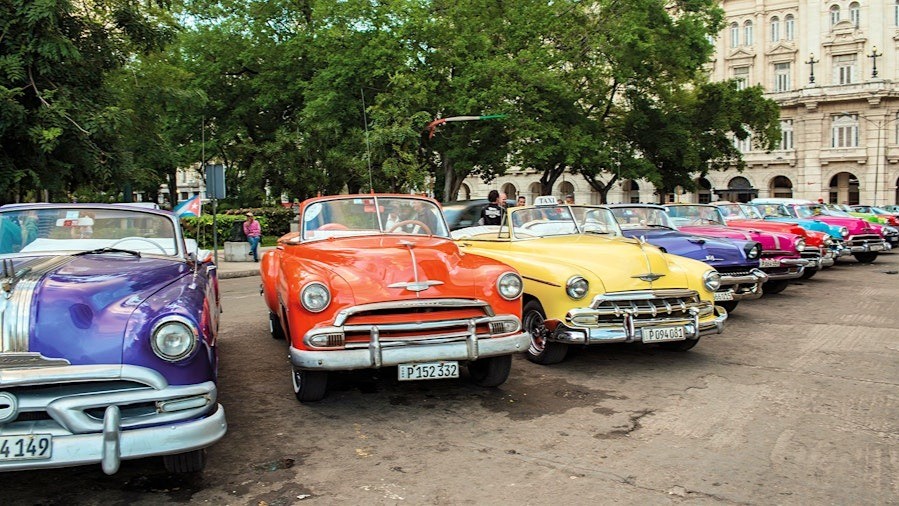
The next morning, he arrived in a 1956 Pontiac. It wasn’t the glossy kind you see on postcards, but it ran smooth and proud, the year of my birth. He smiled, said nothing about money, and waved me in. “Pay me what you want,” he said.
We drove through narrow streets and fields of sugarcane. In Cuba, there’s a law that says if you’re driving and you see someone waiting by the road, you stop and give them a ride. Not optional. You stop. It keeps the country moving, and it keeps people connected.
That’s how we met a woman who worked in a toll booth on the road to the resorts. She was a veterinarian by training but couldn’t earn a living treating animals. So she took coins from tourists instead. She invited us to her home, where she lived with her daughter. The apartment was simple and full of pride. Old furniture, religious pictures, quiet dignity. Her daughter had the flu, sitting there in a chair, wrapped in a blanket. When I left, she ran to me and gave me a hug so big it caught me off guard. I never forgot it.
At lunch, we stopped at El Chino’s house. His wife had given birth to a daughter six weeks earlier, and they brought me upstairs to see her. His teenage son, a bright-eyed math prodigy, joined us at the table. El Chino had gone fishing the day before and fried the catch for us himself. It was one of the best meals I’ve ever had. He also served homemade pork rinds, which I didn’t much care for, and I quietly passed them to the family dog when no one was looking.
Later, a man crossed the street and joined us. He was the doctor who had delivered the baby. He spoke a little English. We talked about medicine and money. In Cuba, doctors make about fifty dollars a month, he told me. Bus drivers make three hundred. So many doctors take second jobs as mechanics or teachers to survive.
We walked through the centre of Morón afterward. El Chino introduced me to everyone, and every greeting came with that Cuban handshake: a sharp draw of the arm as if to punch, followed by a joyful clasp. It was loud, sincere, and full of life. The kind of gesture that said, we’re still here.
He showed me the stores, the shoes that cost more than a month’s pay, and the buses that circled the town. We sat at a café and drank sodas—no Coke in Cuba, of course—and watched a polished 1957 Chevy pull up. “A surprise,” he said, grinning. It was his cousin’s car, newly restored and gleaming. We switched vehicles for the afternoon. I later learned it had been rebuilt in Miami before somehow finding its way back to the island.
We drove again through the countryside, past sugarcane and cattle fields. Cows are precious in Cuba. You can’t kill one yourself—it’s a two-year prison sentence if you do. Only the state can process beef, mostly for the resorts. There are few refrigerators in the country, so private slaughter would mean waste and illness. It’s not control so much as survival, shaped by scarcity.
By late afternoon, he dropped me off at my carcedoro. I was nervous about what to pay him. I thought of the doctor, the bus driver, the prices of shoes. I handed him a hundred pesos—nearly two months’ wages for a doctor, a week’s pay for a bus driver—and waited for his reaction. He smiled, said thank you, and that was all.
When I left Cuba a few days later, he was waiting at the hotel with a gift: twenty-six cigars he had rolled himself, all in the lighter, smoother style I preferred. He said nothing about the money. Only that he hoped I would come back.
I did return to Cuba, years later. He was gone. People said he might be in Miami. I hope he’s well, and that his daughter, the baby I met, has found her way in the world.
That day in Morón never left me. It taught me that kindness and pride can outlast any government, that warmth can live beside want. The Cubans call their resorts carcedoros—golden prisons. Maybe they’re right. But for a single day, I was free in the real Cuba.