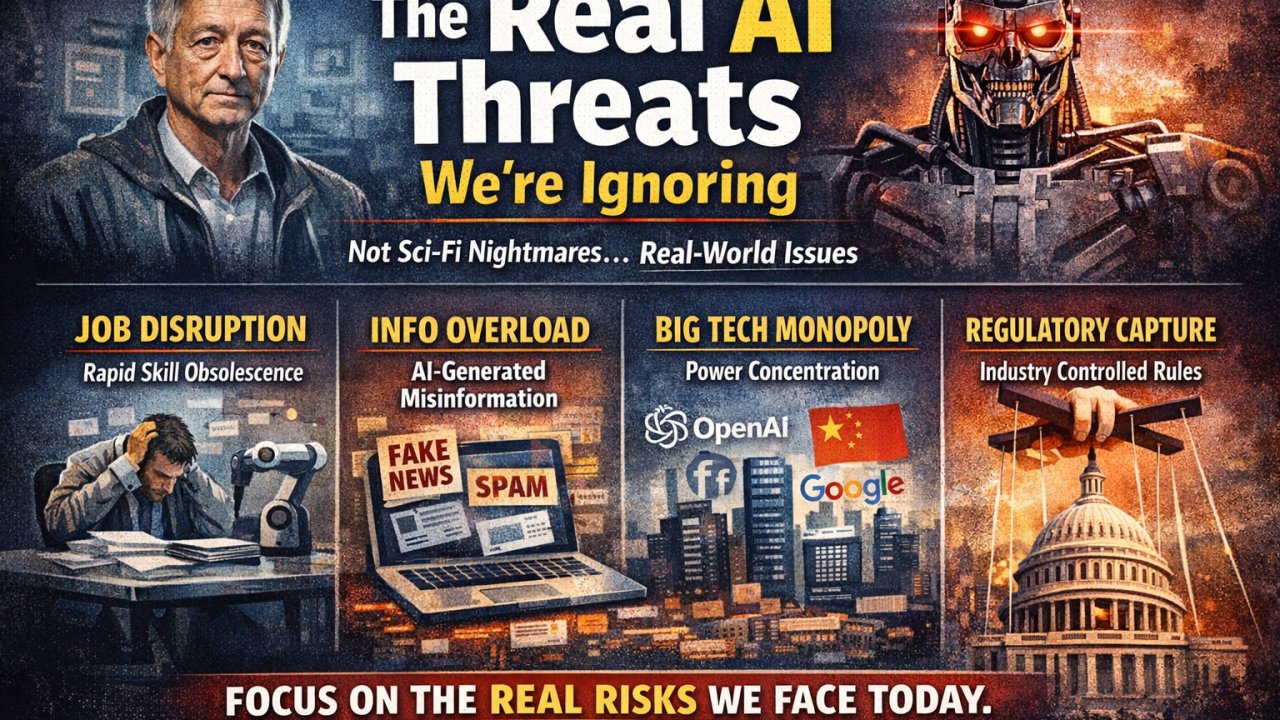
In 2023, Geoffrey Hinton left Google and started giving interviews about existential risk. One of the godfathers of deep learning, the researcher who'd spent decades proving neural networks could work, was now warning that AI might pose risks to human survival. The media loved it. "Godfather of AI warns of existential threat" made perfect headlines.
Around the same time, prominent AI researchers and tech leaders signed open letters calling for pauses in AI development, warning about risks to civilization, comparing AI to nuclear weapons or pandemics. The Terminator scenario — AI becoming conscious, deciding humans are the problem, taking over — dominated the conversation.
These scenarios are conceptually possible. They're not obviously stupid. Smart people take them seriously and work on technical approaches to prevent them. But here's what's interesting about the timing and emphasis of these warnings.
The people most prominently warning about existential AI risk often have significant financial stakes in AI development. Sam Altman, who testified to Congress about AI risks requiring regulation, runs OpenAI. Demis Hassabis, who speaks about the need for AI safety, runs Google DeepMind. They're not wrong to be concerned. But they're also competitors in an industry where regulatory barriers favor incumbents.
The open letter calling for a pause in AI development got enormous press coverage. It was signed by many people who had no intention of actually pausing. OpenAI didn't pause. Google didn't pause. Anthropic didn't pause. The letter created PR value and regulatory pressure without requiring anyone to actually stop competing.
And while we're focused on hypothetical future superintelligence, actual present-day disruptions are happening with much less attention.
AI is very good at certain tasks: pattern recognition, text generation, image creation, code completion, data analysis. These capabilities automate parts of jobs, not entire jobs. The disruption isn't mass unemployment. It's rapid skill obsolescence for specific professional roles, combined with downward pressure on wages for tasks AI can assist with. Junior positions that used to be training grounds become less necessary. Mid-career professionals need to adapt to working with AI tools.
The second threat is information ecosystem collapse. Generated content is becoming indistinguishable from human-created content. Text, images, audio, video — all can be generated at scale, cheaply, convincingly. The internet worked because content required effort to create. That effort was a filter. Now you can generate millions of plausible blog posts, social media comments, product reviews — all coherent, all superficially reasonable, all with no human author who believes or cares about the content. The cost approaches zero.
The companies controlling these access points are using safety arguments to justify that control. "We need to test models before release." "Open-sourcing is dangerous." Each argument, while having some validity, also serves to maintain the position of current leaders. This isn't a conspiracy. It's incentives. If you've invested billions in AI development, you benefit from barriers that prevent competitors.
The fourth threat is regulatory capture, which follows naturally from the third. When governments write AI regulations, who do they consult? The companies building AI systems. OpenAI, Google, Anthropic testify. Their executives advise. This isn't corruption — it's expertise. These companies genuinely know more about AI than regulators do. But it creates a dynamic where regulations tend to codify what incumbents already do while making it harder for newcomers to compete.
Rapid professional skill obsolescence creating economic disruption
Information ecosystem degradation from generated content at scale
Power concentration in a handful of companies controlling critical infrastructure
Regulatory capture that entrenches that concentration under safety justifications
These are happening now. They're measurable. They're affecting real people and institutions. And they're getting less attention than hypothetical future scenarios.
But here's the thing about humans: we're extraordinarily good at adapting to disruption. We reorganized entire civilizations around agriculture. We adapted to the industrial revolution. We integrated the internet into daily life. We made smartphones ubiquitous. The pace keeps accelerating, and we keep adapting. Not smoothly, not without pain, not without people and communities left behind. But we do it.
AI disruption will be measured in months and years, not decades. That's unprecedented. But humans have one advantage that's unique among species: we can completely reimagine how we organize society and implement those changes within a single generation.
We're already seeing it. New job categories emerge. New institutions form. New regulations develop. New social norms establish themselves. The adaptation is chaotic and imperfect, but it's happening at remarkable speed.
But here's the hopeful part: we know how to address these problems. We have history with managing disruptive technologies, building institutions, regulating monopolies, protecting workers, ensuring competition. We're not facing unprecedented challenges — we're facing familiar challenges happening faster than usual.
Humans are the species that learns and adapts. We're not the strongest or fastest. We're the ones who change our behavior, reorganize our societies, and thrive in new conditions. Betting against human adaptability has historically been a losing bet.
The scientists wrote the score. The engineers built the concert hall. Now we have to decide what kind of performance we want and who gets tickets. That's not a technical decision. It's a human one.
And unlike AI systems, humans are pretty good at making decisions about the world we want to live in. We just have to actually make them before the decisions get made for us.