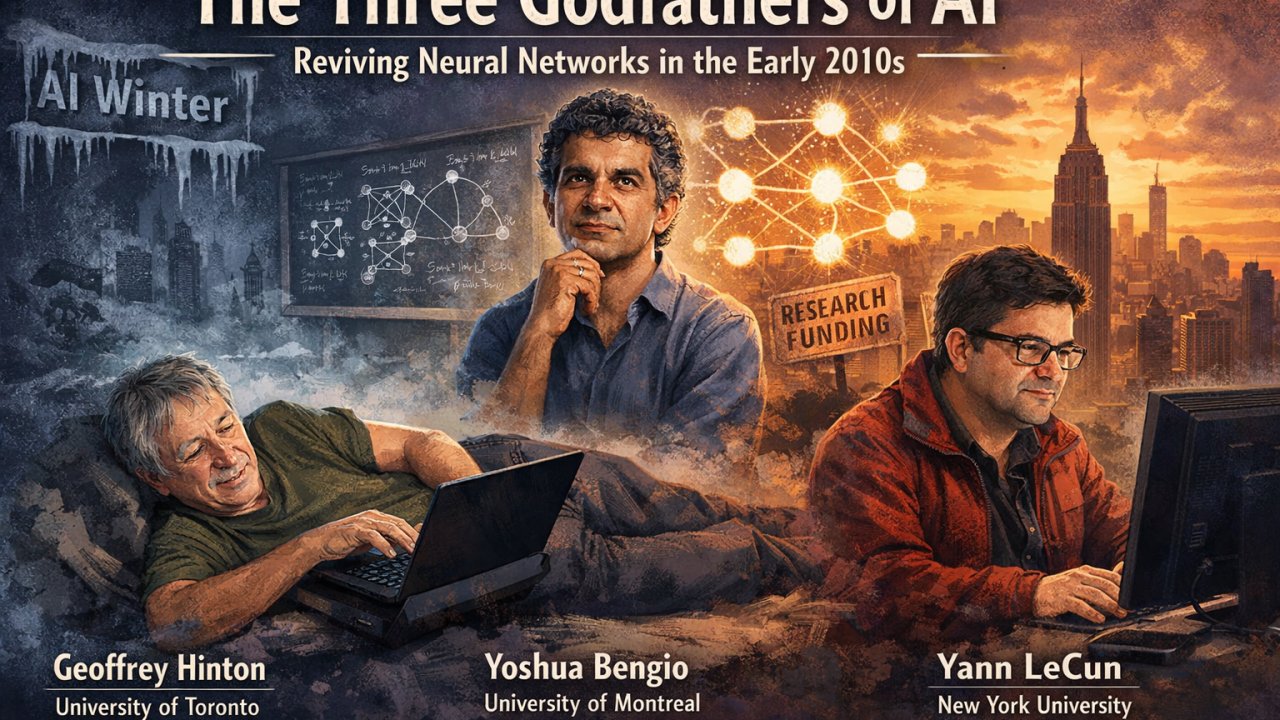
By the early 2010s, artificial intelligence had a credibility problem. Neural networks had failed spectacularly in the 1980s, leading to what researchers called the "AI winter" — a period when funding dried up, careers stalled, and the whole field became somewhat of a joke. Mentioning neural networks at a conference might get you polite nods and career advice to work on something more promising.
Three researchers refused to give up. Geoffrey Hinton at the University of Toronto, Yoshua Bengio at the University of Montreal, and Yann LeCun at New York University kept working on neural networks through the wilderness years. They weren't chasing wealth. They were chasing an idea that everyone else thought was dead.
Hinton had chronic back pain so severe he often worked lying on the floor. He'd position his laptop on his stomach and code that way, or think through problems flat on his back while his colleagues sat in chairs. The pain became part of his routine, a physical reminder that sometimes you have to find unconventional positions to see things clearly.
Bengio stayed in Montreal when he could have gone to Silicon Valley. He built a research group at the University of Montreal, trained students, published openly, and turned down offers that would have made him rich. Montreal winters are brutal. The tech money was elsewhere. He stayed anyway.
LeCun moved around more — Bell Labs, then NYU, then Facebook in 2013 as their Chief AI Scientist. But even at Facebook, he fought to keep research open, to publish papers, to share code. He believed in building a community, not a moat.
They were friends and rivals, collaborators and competitors. They built on each other's work, argued about techniques, shared students and ideas. When one made a breakthrough, the others would extend it, challenge it, improve it. This wasn't a zero-sum competition. It was a conversation spanning decades.
The breakthrough that changed everything happened in 2012. Hinton and two of his graduate students — Alex Krizhevsky and Ilya Sutskever — entered a computer vision competition called ImageNet. They used a deep neural network trained on GPUs, an approach most researchers considered outdated. They won by a margin so large it was almost embarrassing for everyone else. The error rate dropped from 26% to 15% overnight.
Suddenly neural networks weren't a joke anymore. They were the future. And the three researchers who'd kept the faith through the winter years became the "godfathers of deep learning." In 2018, they shared the Turing Award — computer science's Nobel Prize. The vindication was complete.
But vindication and wealth are different things.
Hinton, Krizhevsky, and Sutskever sold their tiny startup DNNresearch to Google in 2013 for around $44 million. Hinton went to Google as a distinguished researcher. He left in 2023 — not to cash out, but to speak freely about AI risks without being seen as representing Google's position. At 76 years old, he wanted to say what he thought without corporate constraints.
Bengio co-founded Element AI in 2016, a Montreal startup that sold to ServiceNow in 2020 for much less than the hype had suggested — around $230 million. He still lives in Montreal, still teaches, still publishes openly, and has become one of the most vocal advocates for AI safety and ethics.
LeCun became Meta's Chief AI Scientist in 2013. Of the three, he probably has the most conventional tech-industry wealth. But even at Meta, he's been the voice arguing for open-sourcing models, for making research public, for treating AI as infrastructure rather than proprietary advantage.
This pattern runs through the entire history of AI.
The question "did they get rich?" is almost beside the point. The three godfathers could have been richer. They could have been more secretive, more proprietary, more focused on capture instead of sharing. Hinton could have patented techniques instead of publishing them. Bengio could have taken Silicon Valley money and built a closed research lab. LeCun could have kept Facebook's AI research locked down instead of fighting to open-source models.
They chose differently. They published papers. They open-sourced code. They trained students who went on to found companies and make breakthroughs of their own. They built a research community instead of a competitive moat.
In 2024, Hinton, Bengio, and LeCun remain active and influential. Hinton speaks about AI risks and the need for safety research. Bengio works on AI governance and ethics, arguing that the technology needs guardrails. LeCun argues the opposite — that openness and democratization are the real safety strategy, that concentrating AI power is more dangerous than distributing it.
They're still friends. They still disagree. They're still having the conversation they started decades ago, just with higher stakes and a much larger audience.
The three godfathers wrote the score that everyone now plays. They proved neural networks work. They kept the faith when faith was unfashionable. They shared what they learned. And that choice — to build knowledge rather than moats, to create community rather than competitive advantage — may be their most important contribution of all.